Network Online Course
Lesson 3 - The Physical Network
A. Cable Concepts
Cable Concepts
- Attenuation
- Impedance
- Electromagnetic interference
- Crosstalk
Cable concepts
Before discussing transmission media, it is useful to discuss concepts that apply to cables in general. These factors affect the various cables in different ways and make the usage of the cables desirable or undesirable in disparate situations. It would be nice if a single cable could reach the destination device, no matter how long the distance. Some of the following factors conspire to prevent this happening.Attenuation
Attenuation simply means that the signal becomes weaker the further it travels. Resistance in the wire or outside interference degrade the signal until its message can no longer be decoded. Each cable type has a maximum distance which is defined in the specifications for the network. The maximum distances are documented in the latter parts of this chapter and it is important to memorize them in preparation for your exam.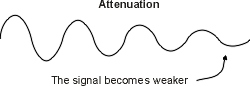
If the cable run is insufficient to reach the destination, a repeater or amplifier is required to extend it. A repeater is used if the signal is digital; an amplifier is used for an analog signal.
Impedance
Impedance is the opposition to a current flowing dynamically in a transmission media. It is a complex measurement made up of inductance, resistance and capacitance. Impedance is measured in Ohms and the symbol representing Ohms is Ω.Why bring up this rather technical topic? Because cable is rated by it and it must match the other components on the network. For example, the coaxial cable used by Ethernet is rated at 50Ω whereas the unshielded twisted pair cable used by the same network is rated at 100Ω.
What happens when you want to use cable with the wrong impedance on your network or connect two mismatched cables together? The device you need is a BALancing/UNbalancing resistor, called a BALUN for short.Electromagnetic Interference
Electromagnetic interference (EMI) affects electrical signals whether traveling in a cable or being broadcast through the atmosphere. EMI can disrupt the signal or degrade it sufficiently so that it becomes unintelligible. It can be produced by many sources including electric motors, flourescent lights, other broadcasting equipment and even sunspot activity.Some cables are shielded to protect against EMI. Typically the shielding takes the form of a copper or aluminum braid or foil which surrounds the conductor used to transmit the signal. Both coaxial and shielded twisted pair cable take this approach. If total immunity from EMI is required, fiber optic cable is used. Since it uses light instead of electricity, it is not effected by EMI.
Crosstalk
Cross talk is interference from adjacent cables that are close together and running side by side. Twisted pair cable has this problem. In fact, the twists in the conductors are put there specifically to try to counter this problem. As the cables twist about each other, the polarity of the signal reverses, nullifying the crosstalk to some extent but not eliminating it fully. You may have experienced crosstalk yourself on a telephone line if during a call, you overheard an unrelated conversation.The measurement for crosstalk is called NEXT (Near End Crosstalk). It is so named because the test instrument makes the measurement where it is attached to the wire, the near end.
Exercise 3-1: Cable concepts
Answer the following questions.1. _______________ is a measure of crosstalk.
2. _______________is a loss of signal.
3. _______________ can disrupt electrical signals.
4. _______________ is a measurement of the complex resistance to current flow.
5. If the electrical signal becomes too weak and you have to extend the cable, you would use a __________ or an ____________.
6. If your electrical signals were being disrupted by interference, you could switch to ___________ copper cable or non-metallic _____________ cable.
7. One measure which minimizes crosstalk is _________ the conductors.
8. If you need to connect two cables which have different impedances, you would use a ___________.
Digital vs. analog
- Digital is on and off signaling
- Only two conditions are possible
- Analog is variable
- Content is determined by strength, amplitude or frequency of a signal
Definition: Digital
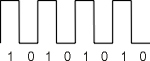 Digital refers to on and off signaling. There can only be two conditions in a digital system, on or off, 1 or 0,
positive or negative, black or white. On is represented by a 1 and off is represented by a 0.
Because there can only be two conditions, a digital system is also binary. All
communications with and within a computer are in a digital form. If they originate in some
other form they must be converted before communications is possible. One unit of information
is stored in a computer as a BInary digiT or a “BIT”. The opposite of digital is analog.
Digital refers to on and off signaling. There can only be two conditions in a digital system, on or off, 1 or 0,
positive or negative, black or white. On is represented by a 1 and off is represented by a 0.
Because there can only be two conditions, a digital system is also binary. All
communications with and within a computer are in a digital form. If they originate in some
other form they must be converted before communications is possible. One unit of information
is stored in a computer as a BInary digiT or a “BIT”. The opposite of digital is analog.
Definition: Analog
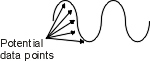 Analog refers to the content of a transmission being determined by the strength, amplitude or
frequency of a signal. Far from having only two conditions, an analog signal can have an
infinite number of conditions. Voice is an example of an analog signal.
Analog refers to the content of a transmission being determined by the strength, amplitude or
frequency of a signal. Far from having only two conditions, an analog signal can have an
infinite number of conditions. Voice is an example of an analog signal.
Sometimes the digital and analog worlds must interface with each other. Then a signal conversion must take place. A good example is sending digital computer data over the analog voice telephone system. The form of the analog carrier wave on the telephone system must be changed (modulated) so that it carries the digital encoding. In fact, this is exactly what a modem does.
Baseband vs. broadband
- Baseband uses complete bandwidth
- Is digital
- Broadband shares bandwidth
- Cable supports multiple channels
- Is analog
Baseband transmission
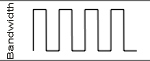 Baseband signaling uses the complete bandwidth of the cable system. Therefore, only one
signal is ever found on the cable at one time. The signal is digital and can be electrical or
light. The system is simple and is well suited to local area networks.
Baseband signaling uses the complete bandwidth of the cable system. Therefore, only one
signal is ever found on the cable at one time. The signal is digital and can be electrical or
light. The system is simple and is well suited to local area networks.
Broadband transmission
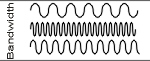 If the cable must carry multiple signals simultaneously, a broadband system must be used. How
is this accomplished? For one thing, the signals are analog, not digital. This means they can
exist as different frequencies and multiple signals, at different frequencies, can coexist on
the cable. Broadband systems are more sophisticated and more complex than baseband and not
considered suitable for most LANs. However, they do have their uses. Your personal experience
with a broadband system will be in the form of cable TV, 200 channels but not a decent movie
on Saturday night.
If the cable must carry multiple signals simultaneously, a broadband system must be used. How
is this accomplished? For one thing, the signals are analog, not digital. This means they can
exist as different frequencies and multiple signals, at different frequencies, can coexist on
the cable. Broadband systems are more sophisticated and more complex than baseband and not
considered suitable for most LANs. However, they do have their uses. Your personal experience
with a broadband system will be in the form of cable TV, 200 channels but not a decent movie
on Saturday night.
Broadband transmission is only in one direction, which explains why the cable TV companies have had to massively re-engineer their systems in order to deliver the Internet via cable. Two way communications is achieved by assigning one frequency to transmit and a different one to receive (mid-split broadband) or using a dual cable configuration.
Transmission Media
- Bounded vs. unbounded
- Coaxial cable, twisted pair and fiber optic
- Radio waves, infrared, microwave and satellite
Bounded vs. unbounded
One key difference between transmission media is whether the signal is constrained in a channel. If it is, it is bounded and is propagated through a copper or fiber optic cable. If it is unbounded, the signal is propagated in all directions, or even if tightly focused, still spreads out. Good examples of the latter include radio waves, infrared, microwaves or satellite.Cable types
Cable used in modern communication systems falls into three categories, coaxial cable, twisted pair or fiber optic.Wireless communications
Wireless communications generally makes use of one of four technologies, radio, infrared, microwave or satellite transmissions.Each of the above technologies has strengths and weaknesses and each will be examined in turn.
Exercise 3-2: Cable concepts crossword
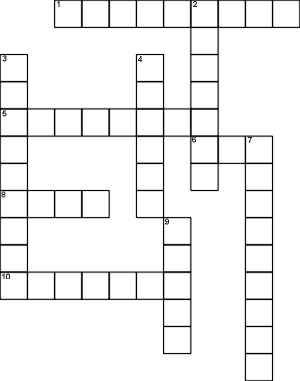
Fill in the crossword puzzle with these clues.
1. Across: System in which multiple signals can coexist on the cable.2. Down: Signal which travels inside a channel.
3. Down: System in which the signal propagates through the atmosphere
4. Down: Signal with an infinite number of data points.
5. Across: Signaling system which allows only one signal on the system at one time.
6. Across: disrupts electrical signals.
7. Down: measurement of resistance to an electrical flow.
8. Across: measurement of crosstalk.
9. Down: Device which allows the connection of two cables of different impedance.
10. Across: Signals which can have only two conditions.
[Top of page][On to next section]